The Chesapeake Bay was formed over 11000 years ago. Native American tribes centered their world around Chesepoic - the country of the great rivers.
The Boardwalk existed as early as 1930 which was just two blocks long in those days. It was rebuilt many times after being destroyed by hurricanes. The present one is about half a mile long and is a meeting place for the local residents.
I found the best time to click pictures was during sunrise.
People having their morning walk, some jog while others take their dogs for a morning walk.
Fishing enthusiasts would turn up early in the hope of making a catch.
There was a band (The Winstons) playing in the evening and I captured a part of their performance.
The young (and the young at heart) were shaking a leg to the wonderful music.
I found the energy level of the performers quite high as can be seen in the video.
Found a peculiar type of tree opposite the boardwalk. Was it a creeper or was it some sort of parasite on the tree?
Earlier we had dinner at the Vaughan Cheese, run by Megan and Tyler. It was an experience in itself especially regarding the different forms of cheese.
Found a few birds along the bay like the Royal tern.
Trying to identify this bird
There were man made platforms specially erected for the Ospreys for their nesting season.
More on the Ospreys and its nesting habits in the next blog.
Earlier we had been to Annapolis and spent half a day there.
The memorial that I saw at the city dock is the only memorial in the United States that commemorates the actual name and place of an enslaved African, Kunta Kinte.
It reminded me of all that I read (about four decades ago) in the book "Roots" by Alex Haley.
Did some window shopping there.
Here were some recycled articles made from old cans in Madagascar, Africa, for sale.
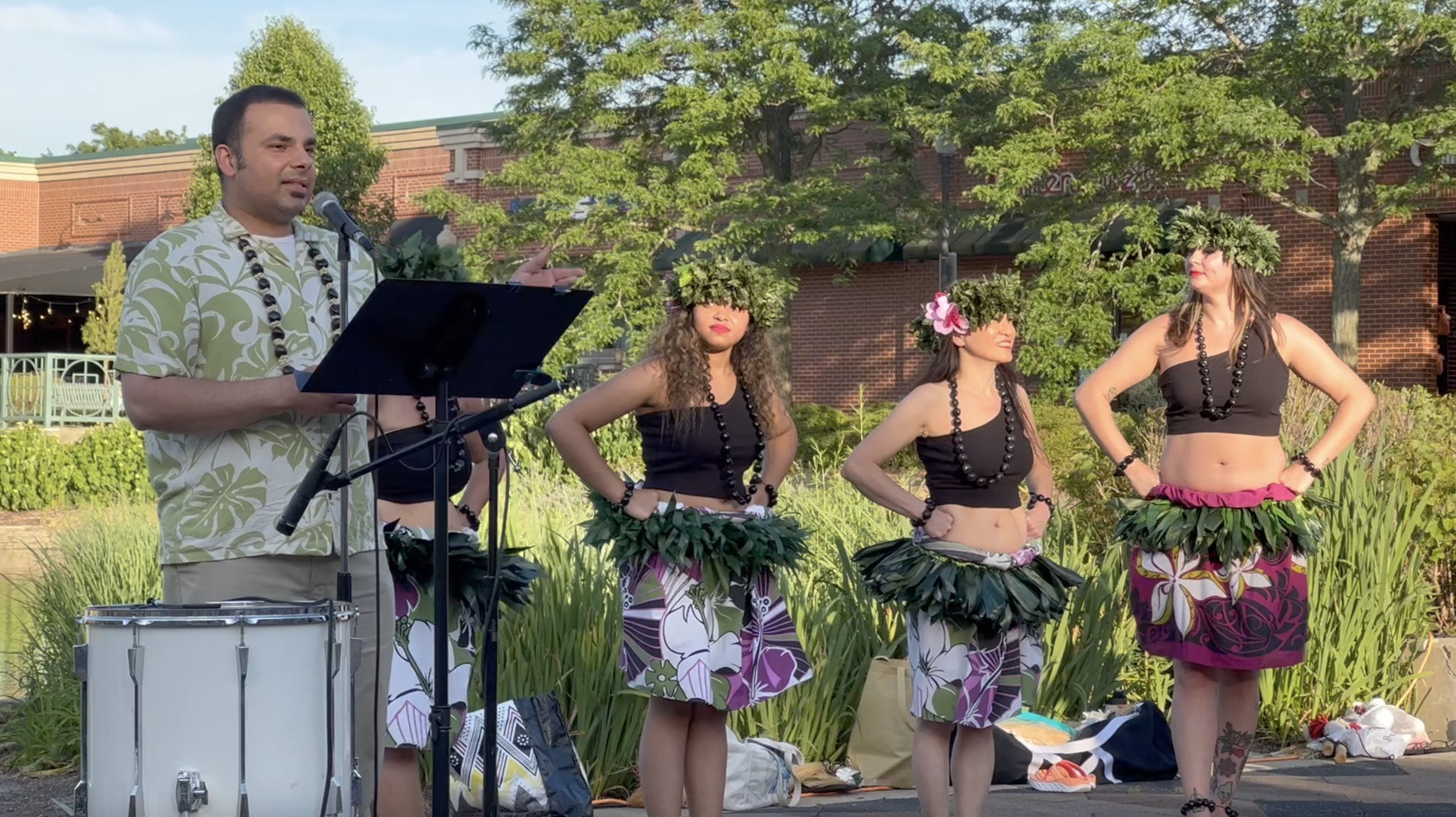
Last evening I had the opportunity to spend some time watching Hawaiin dance by
The Barefeet Hawaiian Inc.
Time well spent I must say. Steve did a good job of anchoring the show using the
right words at the right time.
It was fun to watch the swaying movements of the participating dancers with
their smiling faces.
Among the Hula Dance implements they used, I liked the Puili for the rhythmic
sound it made in sync with the beat of the song.
Other implements used were Uli uli, Poi Balls, and ii
The addition of Elvis Presley's song was a good touch as Elvis had a good
connection with Hawaii including his movie Blue Hawaii. Some young girls came
forward when Steve mentioned learning the basic steps.
The men were equally eager and some stepped forward (barefeet of course) to try
out the steps.
I was a bit worried that some kid would spin the Poi Ball in the wrong direction
and injure someone but care was taken and no one was injured.
I captured what I could (from where I was seated) and put it together to form a
short video.
The first two minutes of the video is Kaluva Pepe, the song featuring Hula from
Hawaii, Otea from Tahiti, Haka from New Zealand and Sasa from Samoan.
As Steve mentioned, he was giving us a taste of Polynesian dance and music. Polynesian
means many islands. I just looked it up on the internet and learned that the
largest country in Polynesia is New Zealand. Here is a picture from
Wikipedia.
As mentioned earlier, it was time well spent. I am sure all those who were
present there, went home with positive vibes.
This morning while cycling down Bode road, I saw these guys playing Bocce ball.
The fact is, I didn't even know the name of the game until I looked it up on the internet.
It is one of the ball sports under the boules family.
This game can be conducted between two players or two teams.
The small white ball known as the Pallino (also known as Jack) is thrown first.
Then each member throws their individual ball, to get it as close to the Jack as possible.
All throws have to be made underhand.
Once all have thrown their balls, they make a visual study to determine who is the closest, and points are decided.
If there is a dispute, a measuring tape is used to determine the distance from the Jack.
The rules are flexible as long as all participants agree to it.
After observing them, I realised that the rules they were following were similar to the game of goti (marbles) that we used to play during our school days.
The scores are updated after each game.
The history of this game is interesting.
Bocce Ball spread throughout Palestine and into Asia Minor. . . . . .
In 600 B.C., Bocce was picked up by the Greeks and passed to the Romans. It was played everywhere, from the churches and castles to the city streets. People from all walks of life could play the game; young or old, man or woman.
In 1319 A.D., Bocce Ball was actually prohibited to people of lesser nobility because it was felt that it diverted attention from more important tasks, such as archery and war training.
As of today, it is an event in the Special Olympics, and is being proposed to be in the Olympics.
They say that if you want to know the history of a place then have a look at the cemetery first. So one morning I pedaled down to the cemetery and found the origin of the name Schaumburg in Illinois.
The original 1842 township survey, names the grove as Sarah's Grove. Three families lived near a grove of woods on the northwest end of the township, and each family had a woman named Sarah (Sarah McChesney, Sarah Frisbe, and Sarah Smith)
At a township meeting in 1850, citizens debated new names for the town. A wealthy landowner named Friedrich Heinrich Nerge, at one point during the meeting, slammed his fist on the table and said in German, "Schaumburg schall et heiten!" ( "It will be called Schaumburg!").
At that point, the township became officially called Schaumburg
Above Black and White picture clicked by Duane Rapp
German was the first language of the majority of households until the 1950s.
The cemetery, with 2600 total grave sites, continues to receive burials today.
Lightning struck the church steeple on July 11, 1904, and set it on fire. The fire, which burned slowly downward, was extinguished by the bucket brigade.
But the steeple was destroyed and had to be rebuilt. The bell was cracked and made useless. In 1956 the Men's Club replaced the bell and memorialized the founders of the congregation by placing it as a monument on the front lawn of the church.
The Schaumburg Center School was one of the five public schools founded in Schaumburg Township in the 1870s.
Originally located at Schaumburg Road, northwest of Roselle Road, (and numbered as 54) it was moved in1981 and restored on its current site on St Peter Lutheran Church property.
This one room schoolhouse is owned by the Village of Schaumburg and is leased to Schaumburg Township Historical Society. Unfortunately I could not have a look inside as it was closed for repairs.
Made a short video of all that I could capture in the morning. The squirrel at the cemetery lawn was eyeing me suspiciously "should I share my breakfast with this guy on a bicycle?"
On the way back I noticed these birds (a Great Blue Heron and Swallow) in the grove. (things that we don't notice when we zip past in a four wheeler)