Monday, June 3, 2013

On the way - Part 2

Traveling is boring for some and it is all the more so when its a daily routine - namely going to work.
 Continuing with the journey . . . . . .  there is a broken culvert that we pass daily and the activity over there is any body’s guess. As the water over here is fresh and flowing, you get to see a lot of activity.
It could be a driver, who after having a bath washes his auto rickshaw

Or it could be someone cleaning his scooter  


Sometimes the vehicles carrying the green leafy vegetables make a stop over to wash their bunch of palak and methi (spinach and fenugreek), or it could be a physically challenged  man  who after having a bath , washes his clothes and hangs them out  to dry.

The National War Memorial has undergone a face lift recently.


It is a pleasant sight to see the well manicured lawns with the names  of the soldiers neatly listed down


The flag staff too has been changed to a longer one with a bigger flag. On the way back from work we get to see the flag being lowered with reverence. A procedure followed religiously before sunset.

Next to this War Memorial is a clock tower which rings at every hour. I was pleasantly surprised to hear the ring of the Big Ben when I was passing this  tower exactly at 18:00 hrs.


Those who want to know a little more about the Big Ben and its history, have a look at this video here.  Some interesting facts are given there. 

Every city in India with a military establishment has an RSI and Pune is one of them.


There is this institute “Botanical Survey of India” with  huge trees and a good mansion inside (from the British era). One day I must make it a point to visit and explore this place.

Pune has two rivers and I cross them six times in a day - thrice in the morning and thrice in the evening. In case you are wondering about it, here is a rough layout of how the river winds itself through the city.

The  Fitzgerald  bridge (commonly known as the Yerwada bridge or bund garden bridge) was wide and strong and it had a bund close to it. Its interesting to know that this bund was financed by Sir Jamsetji Jeejeebhoy and was named as Jamsetji Bund. It was created in 1853 to provide water for the poorer citizens of the city.


The above picture shows the bund. It was clicked by an unknown photographer way back in 1870
Now the bund has been demolished to create new bridges on either side.The Fitzgerald bridge still stands with a deserted look. There is a move to make it a walking plaza.  I tried to click a picture from the same point and you can see the new bridge in place of the bund.

Many Bollywood pictures were shot on this bund including the famous song sequence “aaja aayi bahaar…” from the movie Raajkumar starring  Shammi Kapoor and Sadhana.


From the bridge you can see the Tarakeshwar mandir on the hillock.

Below the bridge you can see a make shift dhobi ghat. It has been there for years, maybe due to the easy access to running water.


 Before we move on from the Bund Garden Bridge, lets have a look at how it looked in 1917. Here is a picture I came across which says: 
Poona, India. 1917. Members of the 1st Australian Wireless Signal Squadron, Mesopotamian Expeditionary Force, relax in the gardens while on leave. They were possibly members of the Squadron Headquarters (HQS) or ‘A’ Station. 
You can see the Fitzgerald bridge behind.


Along the curved road to the Bombay Sappers you get to see a temple and a durgah co-existing with each other.

The view from inside the Kaila Chamunda mata mandir is great and one can see the flowing Mulla river from the window.


When ever there is a festivity in the Hajrat Shahdaval Baba Durgah you can see extra stalls coming up outside with some colourful items for sale.


It’s a common sight to see the young recruits crossing the road at the Bombay Sappers (which was earlier known as the BEG) This edifice (made with coloured tiles) looks great from far.

I was just counting the number of pictures in this post and I think it has crossed my self imposed rule of “keep it short and sweet”
So will be continuing the journey in part 3

Wednesday, May 22, 2013

On the way - part 1


Traveling is boring for some and it is all the more so when it’s a daily routine - namely going to work.
Whether you travel by a car or a bus, observing your surroundings and the daily activities can be really interesting.
To start with, its interesting to watch the morning walkers getting along with their brisk morning walk.

If you are lucky you get to see the fag end of the combined exercise activity  by the senior citizens. Everyday the leader keeps changing but the exercise goes on. And then there is the laughter club which some find very amusing.


    The church opposite the Race course is probably one of the oldest one in Pune.


And when you look at it from the other side of the race course, it’s the only landmark in the horizon.

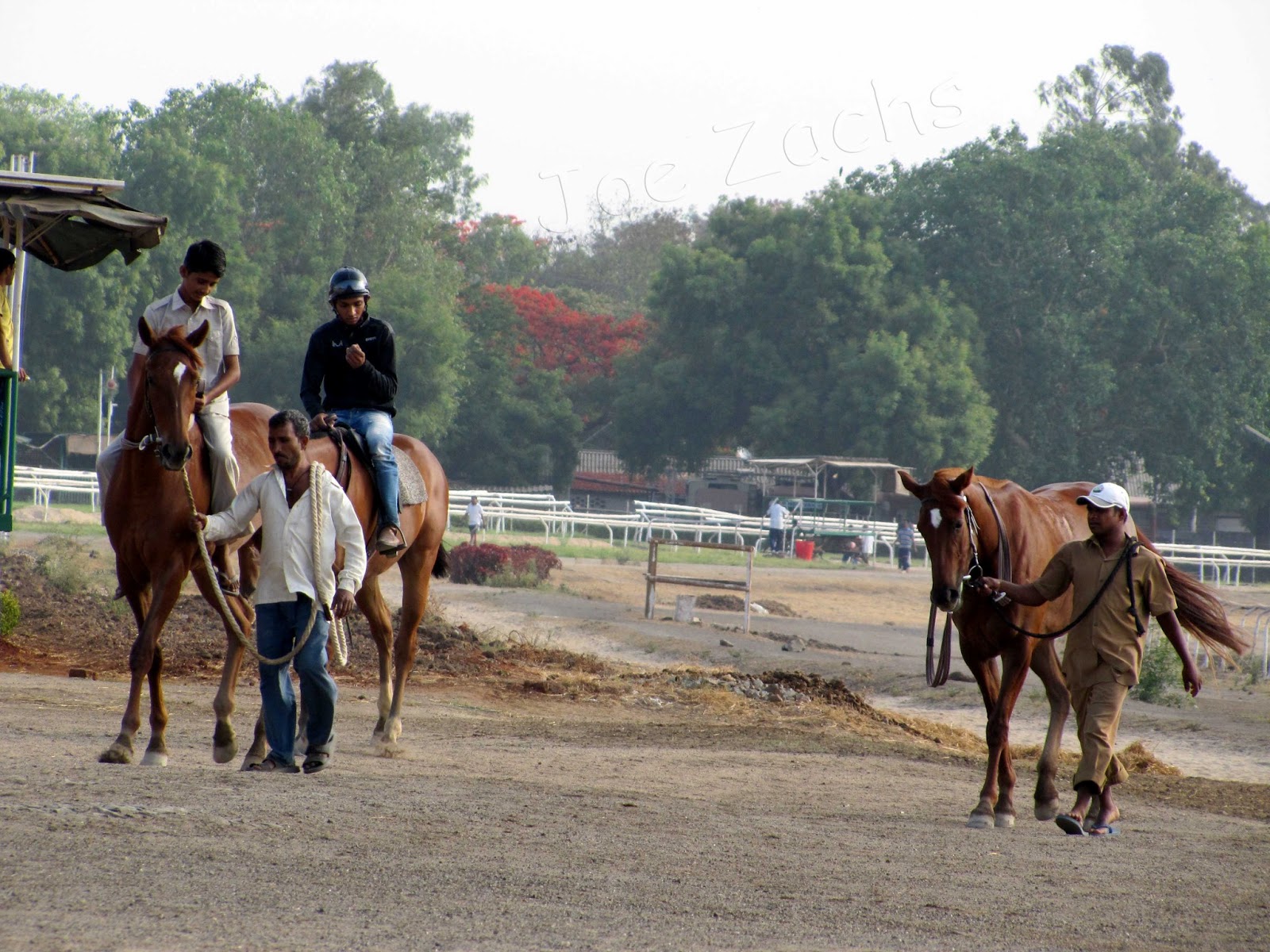
The race course is one of those exciting places. You get to see the horses taken for the early morning training. The horses are wary of the traffic and the cacophony, so the trainer has a tough time holding on to them till they reach the tracks.


Once on the track they just sail through the morning routine of warming up and alternating between a trot and a gallop.


Its good to see people on tracks having their morning walk while the horses move in the opposite direction.

After a good work out they are back in their stables for a much required  rest.

There is a cross road named Victoria road right next to the race course The name of this road reminds me of my school days as our school in Bombay was situated on  Victoria Road (not far from Victoria Garden)  Of course Bombay is now Mumbai,  Victoria Road is Mustafa bazaar and Victoria Garden is Rani baug.


Right behind the Victoria Road sign is the Southern Command Riding school where young guys get their training.

Come summer vacation and you can see a lot of activity here where young boys and girls get a real feel of the horse and horse riding. 

Talking of the Race course you get to see a lot of activity there. Apart from the horses being trained, you come across joggers (who have a different track)


And there are some who do the Surya namaskar the right way -facing the rising sun.


Some believe in walking backwards as they say that it is a better form of exercise.


And after all this the juice vendor is always there to give you your choice of juice.


 I am always fascinated with this tangle of roots and trunks. Wonder how old it is, standing there right on the perimeter of the Empress Garden.


This Garden is one of the oldest in Pune and has some huge trees. Just a sideways glance is enough for one to appreciate the foliage and dense growth there.


From time to time Empress Garden holds some good exhibition cum sale of flowers and saplings. On such days you can expect a minor traffic jam in the evening.
These sugar cane vendors are getting ready with their stock for the day, anticipating the rise in the temperature. The complete contraption is made of wood and is very cost effective. The family pitches in as it requires minimum two people to run the show.


(this is getting to be a long one. . . . . .  so will be continued in part 2)

Wednesday, April 24, 2013

The Temple Elephant


In case you are wondering about this picture, its of an elephant who is having  a nice scrub down.
Had been to this temple in Ernakulam this January and was lucky enough to witness a temple festival that was being held that day.
Had been there in the morning and saw this elephant being given a good bath. On enquiry I was told that they were getting him ready for the festival that was to be held in the evening.


I lingered around, had lunch at the Avenue Regent and was back in the temple premises to see the activity. I could see that the elephants were waiting in one corner of the courtyard of the temple as I entered.


Those rows that you see on the side of the temple are for lighting lamps. One can imagine how wonderful it would look at night from far if all the lamps were lit.

You get to see the kodimaram when you enter any temple in south India. The Kodimaram (flag post – also known as the Dwajasthambham)  is the flag pole which is placed between the Rajagopuram and the Sanctum Sanctorum. It is made of wood, covered with brass, and with or without gold coating. This is something that you will find outside the churches too in south India. The festivities start by the Kodiyettam (hoisting of the temple flag) on this Kodimaram.  


I could see how the elephant were getting adorned. The most important part being the Nettipattam. Legend has it that the Nettipattam was designed by Lord Brahma. Iravath, the white elephant of Lord Indra was the first elephant to wear it. The caparison, which is the part of Hindu astrological art, represents the entire pantheon of gods in Hinduism.  


I tried to take a close up of one of the elephants, and felt that he was looking directly at me. 


The elephant lowered its head to have the replica of the deity placed over its head.  It is an unusual stance for an elephant I must say.


One by one the elephants came and stood in their designated place.


The drummers get ready by wearing their special mundu (dhoti) 


This drummer is fine tuning his drum. This particular drum has got a name. Wonder if someone can enlighten me. 


There was a lamp that was lit and kept in front of the elephants.


The tempo and the rhythm of the people playing the chenda (drums) slowly increased along with the accompaniment of the  kombu (one of the wind instruments) 


You can see Peruvanam Kuttan Marar here, the leader of the Chenda group of the Paramekkavu temple (Last Sunday I saw him on the TV playing at the famous Trichur Pooram)


The Elathalam is made of bronze and has its distinct chime as it is thicker when compared to the normal cymbals. It is one of those instruments that provide the beat.


While the tempo built up, the elephants had lots to chew on (literally) They kept feeding themselves on the leaves of this palm. I was fascinated by the way they neatly pulled out the leaves with the curl of their trunks (marked in the picture below) 


The palms were all prearranged and placed at strategic places. 


These two pictures below shows the understanding between the elephant and its master, or rather I must say the trust level of the mahout.


Meanwhile there were arrangements for making offerings of your choice.  The offerings had their own fixed rates.


It was almost dusk and that helped me to get some good photographs of the drummers. The way the light falls on the subject makes the difference to the photographs. 


It was a wonderful experience and I think I should increase the frequency of my visit to Kerala, now that there are direct flights to Kochi. I did my round trip bookings using the coupons from CupoNation which turned out to be very cheap. One can find them here : https://www.cuponation.in/