Friday, September 26, 2014

Delft Pottery


The tag says that it costs 550 Euros for the set. A bit steep I must say but when you look at the effort that has gone into the making of this pair, I think it is worth reconsidering.

Had been to the Delft Pottery in Netherlands about six months ago. A visit to the factory is worth it if you are in Netherlands.


They take you through a set of articles that are on display with special mention about how it was made. For example “The Night Watchman” is a collection of 480 tiles of 18x18cms.   


 
The original painting of 1642 by Rembrandt was 13 ft x 16 ft. It took more than a year for two master painters to convert this on to the tiles by individually painting them by hand.


The best part was that the tiles were sold even before the painting was over. To this day the owner has loaned the set to the museum so that the visitors can enjoy this unique piece.
Before you enter this section, there is an audio visual display giving you a brief history of how Delft pottery came into Netherlands.


Time stands still on this table with the Delft pottery. 


King Willem III has donated his collection with the condition that it will be exhibited in a "dignified fashion"


Some of the other exhibits


I admire this model who agreed to wear all this pottery and walk the ramp


The old drafting board that was used by them is also one of the exhibits


Further down one can have a glimpse at their factory where each piece is physically examined by a person and final touches given with the help of a leg operated “pottery wheel” 
 
In another corner one can see the artists painting each piece. Don’t miss the transistor in the background. I observed these transistors even in the factory where it was splashed by the paint and wet mud, but who cares, music is more important. 


Further down there is a display of the items that are for sale.


All in all a good experience. Have made a 8 min video with more photographs:


Tuesday, September 16, 2014

Washrooms


It is interesting to see the different signs that are put up in the washrooms of hotels and restaurants.
Some are very simple like these


These are from a hotel in Amsterdam.


The entrance for this one is a common one (for Men and Women) This was in California where we had brunch at the Cliffhouse. The type of art used here is from the early fifties.


This is from La Bularia, an eating place in Amsterdam. From the drawings, one can make out that it is a Spanish joint.


One that I saw in France


I don’t know where I clicked this but the braille letters at the bottom indicate that they have thought of the blind people too.

 
In case people can’t read the “Ladies” sign, there is a picture of a girl alongside it. The drawing of the girl is in Mario Miranda style, but not actually by Mario. This is at the Baga beach, Goa (Hotel Britto)

 
Talking of toilets, I found this feedback system installed in Singapore airport (Changi) very interesting. After using the toilet, you can give your feedback by just pressing a button. What a simple and effective way for instant feedback.

 
Like me, all must have pressed “excellent” as can be seen here.

Coming back to washroom, this is one sign which needs no description. Every Indian anywhere in the world will know the meaning of this. Clicked this in an eating place in the suburbs of Mumbai.


Friday, August 29, 2014

The coconut tree climber

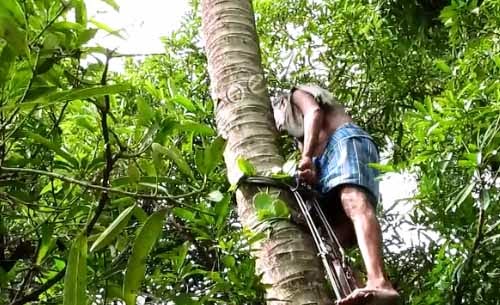
Recently when I had been to Kerala (south India), I saw this guy named Thomachan who came to climb the coconut tree. Everyone kept talking about the “tree climbing machine” But what this guy had was not a machine but a contraption which helped him to climb the tree.

The design was simple. The contraption gets locked on to the tree when you put your weight on it (by stepping on it) There were two, one for each leg.


He carefully strapped the pair on to the tree and climbed up with confidence.  


Once he reached the top, he cut lose all the coconut that was ready to be plucked. In all we got 32 coconuts from this single tree.  


I was comparing this with a black and white picture of mine where I could climb a coconut tree half way without any assistance. (this was clicked about 45 years ago)


OK, in case you are wondering how I did it, this particular tree had nicks carved out in the trunk to enable the toddy tapper to climb up.   

Coming back to our guy Thomachan, while he was gathering all the coconuts, I saw him picking up an aluminium coat hanger. I asked him where it come from. He said “It is usually the crows, they take it from the clothesline to build their nest”   


Now that rang a bell. I remember seeing the same phenomena here in Pune just a month ago. In fact there were two hangers that were used in the crow’s nest here in Pune.


Here it is seen from another angle clicked again after a month. Probably the hangers slipped down after a heavy downpour.


Have to give  credit to the crows that they chose to pick only aluminium hangers (being lightweight) The ingenuity of the crows are universal, even if they are separated by about 1200 kms. (distance from Pune to Cochin)

Have made a small video to show how Thomachan climbed the coconut tree.


Thursday, August 7, 2014

Drumstick flower

Liked the way this single stalk of Orchid stood out, braving the rain and the strong breeze.


Had been for a short visit to Kerala and the heavy rains kept us indoor most of the time but from the window one can see some interesting things, like this irumban puli (Averrhoa bilimbi)


They are good as a substitute for tamarind or tomato in an emergency. They are easy to pluck as they grow low – on the trunk of the tree.


Another view from the window is this big bunch of banana.


We may have to wait for another month to cut it down, but there is no harm in cutting its flower (some call it Banana hearts)  We did just that and made it into a lovely curry. (the flavour resembles that of the artichoke


A close look at this rope showed some busy ants. When I followed their trail, I found that they were building their home in one of the low slung trees. We humans can learn a few things by observing their team work. 


I spied these flowers on the drumstick tree.


Always liked the side dish that was prepared from the drumstick flower. So I collected as much as I could, and carefully removed the flowers and segregated them.


These were properly washed and soaked.


After draining the water they were sauted on slow fire. Added some grated coconut and further sauted them.

The end result was really sumptuous.


Drumstick flowers prevent frequent infection of the throat, chest and the skin.
(all pics clicked in and around the house)


Next post - some more on the Kerala trip.