Clicked some leaves against the sunlight in this rainforest.
The suspension bridge at Capilano is in this rainforest and it is one of the tourist attractions of Vancouver.
The video gives you an idea about the height of the bridge from the river bed. If you are prone to motion sickness or have fear of heights, then be warned that it can sway quite a bit with a crowd on the bridge.
The bridge was originally made of hemp ropes and cedar planks. Some of the tools used in those days to put up the bridge.
There are more smaller bridges connecting the treetops.
There is a Cliffwalk which is the latest addition around the place.
Noticed a tree while walking on the cliff walk. The angle that it has taken while growing.
Nature has its own way to find the sunlight especially in a rainforest where trees are dense.
I spotted a solitary owl on one of the tall trees and took some snaps. It being noon, the lighting was not favourable and it cast some sinister shadows on the owl's face.
It was our first experience traveling by Alaska Airlines to Vancouver and found the airline pretty good.
Talking of Vancouver port, it is considered to be one of the most beautiful ports in the world. Some of the old and the new co-exist on Burrard St. at Downtown.
Saw some trolley buses on the way from the airport. I remember this was in use in the late 60s in Bombay (now Mumbai)
Not far from Burrard St is the "Canada Place" conamed as "Komagata Maru Place" in honour of an incident when the Komagata Maru steamship (also known as Guru Nanak Jahaz) brought 376 Punjabis (337 Sikhs, 27 Muslims 12 Hindus) to Vancouver, most of whom were denied entry, detained for two months with lack of medical aid, food or water and then forced to return to India where many were killed by British authorities.
There are other pictures about the history of the place, displayed along the harbour, like how they cleared the big trees:
Saw some seaplanes (used for sightseeing) landing at the same location.
The first thing that greets you as soon as
you land on Ross Island are the deer. They are friendly and gather around you, (mainly
looking for food)
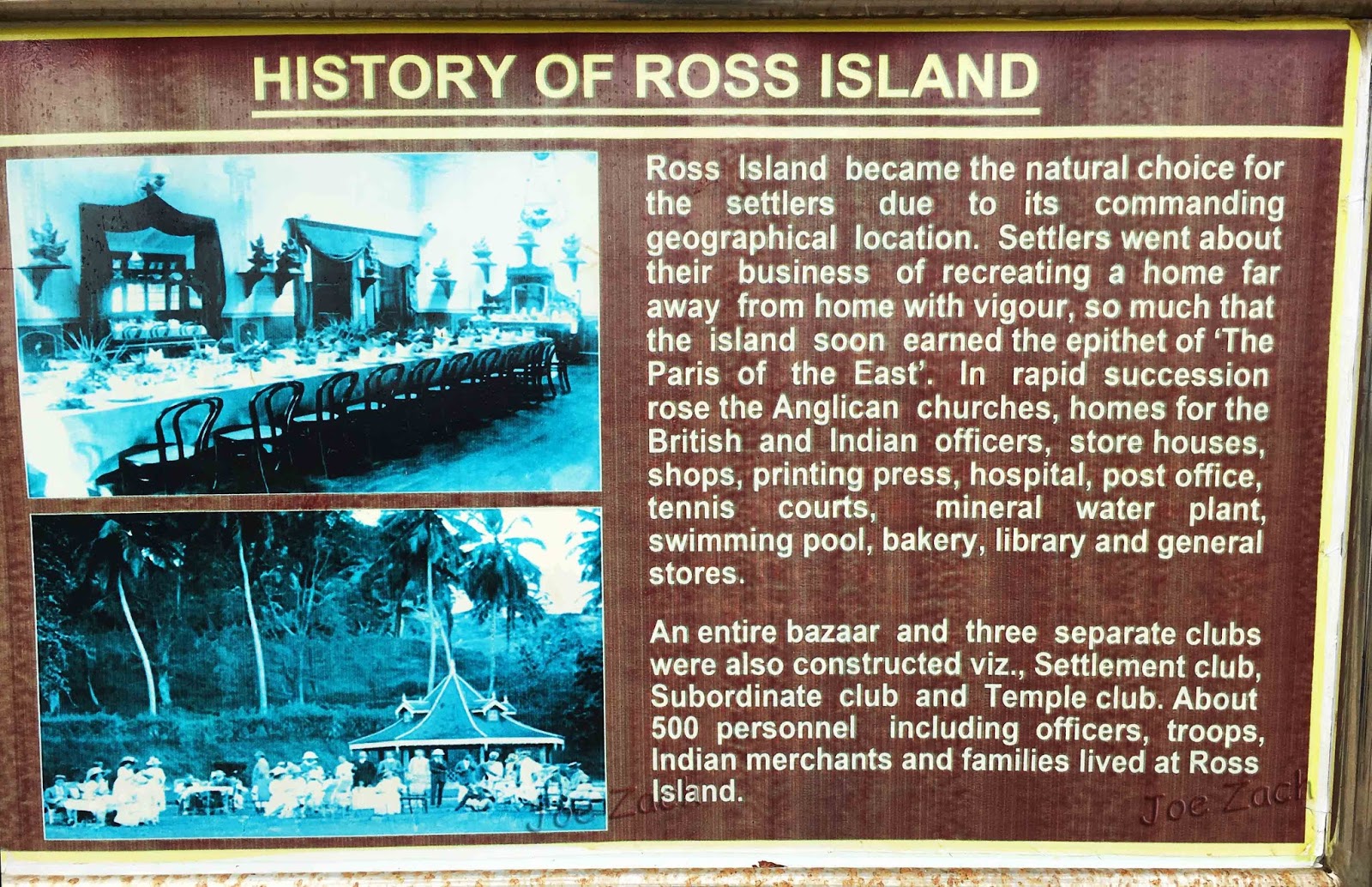
There were instances where the deer tried to escape from the island, maybe due to lack of food or drinking water. The island gets its name from Daniel Ross, a
marine surveyor. It became the natural choice for the settlers (British) due to
its commanding geographical location. Settlers went about recreating a home far
away from home with vigour, so much so that the island soon earned the name of “Paris of the East” Soon churches, homes
for the British and Indian officers, store
houses, shops, printing press, hospital, post office, tennis court, mineral
water plant, swimming pool, bakery, library and general stores came up. An
entire bazaar and three separate clubs were constructed. About 500 personnel
including officers, troops, Indian merchants and families lived at Ross Island.
The bakery still stands, but is in ruins.
And so are some of the living quarters
Since 1979 the Indian Navy has set up a small
permanent post here. No one is allowed to settle on the island. What you get to see are a few air raid bunkers
like this one, built by the Japanese during their reign at the fag end of WW-II
There are very few who has been to Ross Island
and not met Anuradha Rao.
Its
been a life time that she was on the island and has a good rapport with the
animals and the birds. The deer, squirrel, and birds respond
to her call.
Once while feeding the deer I noticed a squabble
between two deer. She immediately called out to them by their name and told them
to stop the fight. That is when I realized that she had names for each one of
them.
When the Japanese invaded, her grandfather,
who was involved in the Indian freedom struggle at that time, was a prisoner of
the British on the island. He was executed by the Japanese on the suspicion of
being a “British spy” The bread that she feeds them is without yeast. She says that Yeast is not good for the deer and can even kill them.
The island which was 200 acres in size, lost
about 130 acres due to the earthquake in 1941. The 2004 tsunami also took its
toll of the island but on a lesser scale as the main impact was on Nicobar and
not Andaman.
Like Ms Anuradha Rao said, “its only when you visit such places and
understand their history that you can comprehend the scale of the sacrifice
made by people of another generation, so that we can live in freedom”
Some
places look marvellous when you view it at night. I tried to get some pictures,
mainly monuments and churches and then tried to photograph it from the same
place in the night. The latest is the Bharat Ratna J R D Tata bridge, a
multi-layered flyover at Nashik Phata, Pune.
The
same bridge has a wonderful lighting scheme during the night.
The
St Patrick’s Cathedral in Pune (opposite the Race Course) is about 164 years
old and was built in the Gothic style.
At
night you can’t miss it when you drive down the Empress Garden road.
The
Red church is another landmark in Pune. Though commonly known as the “Red
Church” it is actually a Synagogue. This picture was clicked many years ago.
Of
late photography is not allowed in the premises (due to security reasons) so
instead of a night shot I clicked a silhouette of it from my vehicle when I
stopped at the traffic light.
The
St Mary’s church (built in 1820) is one of the oldest churches in Pune.
Being a garrison church, it contains many memorials of the British soldiers who served
in various wars and battles. The church is well lit and looks colourful in the
night.
As
mentioned in one of my previous blogs, the Fitzgerald bridge
(commonly known as the Yerwada bridge or bund garden bridge) was wide and
strong and it had a bund close to it.
It
is interesting to know that this bund was financed by Sir Jamsetji Jeejeebhoy
and was named as Jamsetji Bund. It was created in 1853 to provide water for the
poorer citizens of the city.
The
Taj hotel in Mumbai was easy for me to click as I stayed at a friend’s place
which was close to the Taj.
The
same looked different with the Arabian sea as the back drop during the day time.
This was clicked much before the 26/11 terrorist attack in 2008.
Interestingly
three of the five examples given above have something to do with the Tatas.
And
talking of the Tatas, I saw this Nano (a Tata product) parked on MG road in Pune.