Friday, October 25, 2013

Seventeen million years

Wifey: “How come you have written so many blogs about our trip but no mention about the Grand Canyon?”
Me: “Well I am coming to that. Actually there are so many photographs of the Canyon that I am still sorting them”
Wifey: “So you will post my pictures too? I mean the pictures that I clicked?” 
Me: “Why not. If they are good it will definitely find a place”


Wifey:“They are good, there is no doubt about it, after all, I clicked them with my I-pad. You should see how beautiful they looked on the screen. Put up the one I clicked of you when you were fiddling with the camera. When you post them, make sure you put the water mark with my name in a nice and decent way at a corner, and not sprawled all over the picture”

Wifey “I know you liked that one with the setting sun hitting the side of the cliff “


Me “Wasn’t it a good idea that we covered the sunset too the previous day. I remember the first glimpse we had of the Canyon”


Wifey “oh that was just something out of the world, just unbelievable”

The drive from the Hoover dam to the Grand Canyon was a long one and it was just like how I had seen in the movies.  A straight road with arid desert on both sides.

The A/C in the car kept us cool and did not give any inkling as to what the temperature was outside.


As we neared the Canyon the surroundings got more and more green.


I could see some tourists pulling up to get some good close up pictures of the elk that they spotted.


Our aim was to check in to a hotel close to the Grand Canyon so that the next morning we could be at the Canyon to catch the sunrise.
As we reached the vicinity well in advance, we thought why not see the sunset too. Were we glad that we did that.


The lady at the counter was efficient and fast in dispensing the tickets.


The first view of the Canyon:


It is really awesome when you see this wonderful creation of nature for the first time.

What we saw was a minuscule part of it considering the fact that it is 277 mile long, 18 miles wide, with a depth of one mile.
The Colorado river started flowing through this about 17 million years ago where it continued to erode the rocks and form the canyon to its present day configuration.
We went on a clicking spree and just could not stop.


Some just sat at the edge of the cliff taking in the magnificent view.


Was wondering how the rock got eaten up like this:


As the sun went down it become more and more colourful:


These pictures of the sky painted by the setting sun is directly from the camera with no photoshop enhancement (except cropping and watermark)


Some of the tourists came well prepared with tripods and high end cameras.

Finally we headed back to the Lodge (Red Feather Lodge) to spend the night.

Dinner at the Hotel next to our Lodge was a tame affair but I was impressed by the colourful ambiance.


This was at Plaza Bonita Hotel (next to our Lodge)

The next day we went to a different location to catch the sunrise.


Unfortunately the clouds were playing spoiled sport. We waited for a long time to have a glimpse of the sun on that horizon.


The disappointed look on the tourists’ face. You can see that some were sleeping right there the previous night.


While we waited for the sun, I clicked this, showing the variations of rock at different levels (with different colours)


Finally the sun made its presence felt (even though it was for a short time)


Somehow we did not enjoy the sunrise as much as the sun set.
Managed to get some pics later as the sun progressed on its way up:


A dash of welcome green with the sun reflecting off the leaves:


There were many tourists. Some hired those vehicles which were so designed that you had maximum visibility


Some came solo on motorbikes with sleeping mats


The only elk picture that I could get (I am assuming they are elks)


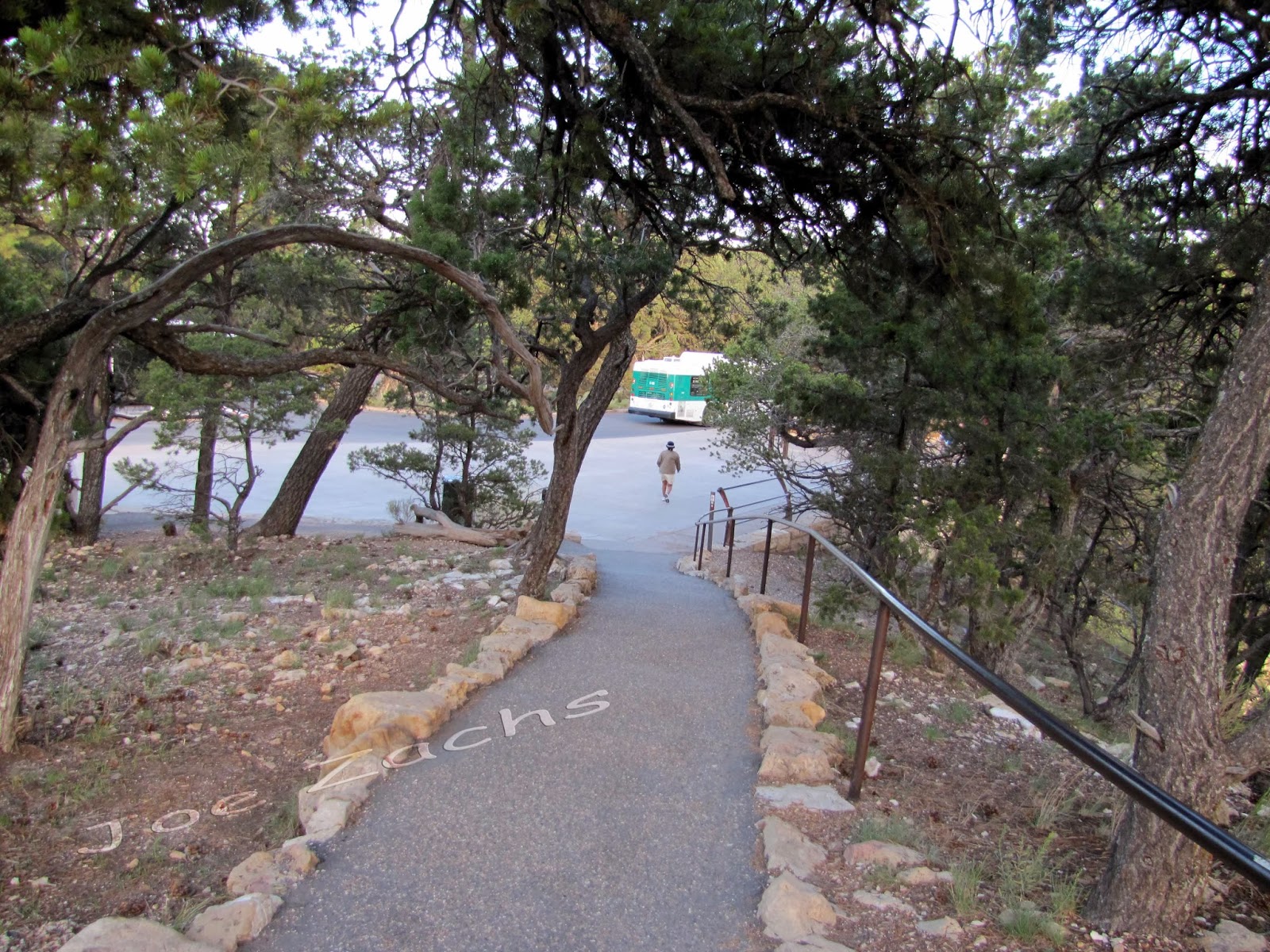
There are buses that run as shuttles from point to point (they run on batteries)
As the sun moved up we clicked more pics 

Some silhouettes : 


Some with backlight:


We did a small trek along the rim (Rim trail of 8.2 kms)


There were some colourful birds around. I could hear them chirping but it was difficult to locate them in the thicket:

At one point we located the flowing river:


I never knew about the blink of a geological eye till I read this:


A moment of rest before we moved on:

There is this problem of people throwing coins into the canyon. I did not see anyone doing it but this board says so.


The ancient inhabitants had a special reverence for this place.


On the way back, I managed to capture the driver and his rear view mirror – or so I thought.


Monday, October 14, 2013

Customer Delight

Was having a look around the terrace garden with the new additions. As usual the tussle between flowering plants and vegetables goes on, with wifey giving more importance to flowers.

I noticed that now she is slowly capturing the walls too.


Not that I have any objections there, but the hard work falls on me, spending a nice Sunday morning drilling holes on those stubborn walls to hang some silly looking things. For me they look like some letter boxes but wifey insists that they are meant to hang flowers. 
I show her around and tell her about the pesticide free green tomatoes and the colourful capsicum that we can have.


“just imagine, we can pluck the ridge gourd  when these creepers grow ”


“and look at these newly planted ones, on the left is the chilly, the middle one is carrot and the extreme right ones are onions. Can you imagine the money we can save on onions.”

Wifey “you always think about saving money. Think about it this way, how beautiful it will look when we will be surrounded by these wonderful red flowers and buds that are growing on the fence”


I thought this was getting us nowhere so we decided to have an equal amount of greenery for both vegetables and flowers.

The next day morning as usual I went to the terrace to pluck a fresh leaf from the Tulsi plant which I use in the morning brew of tea.


As I looked up I saw this perfect web against the morning sunlight.


I was curious about the perfect geometry and the intricate pattern that a spider could create.  Once my tea was ready, I pulled up a chair and sat down and had a close look at this fabulous creation.  
To get some more good shots of the net I rigged up some of the dark clothes on the clothesline as the background.


Those lines looked so parallel and I was wondering how did this guy manage to get those lines so parallel row after row.


 In that perfect circle of web why was a part of it left undone?

Notice those four arcs on the periphery? The complete web is built on those arcs.


It seems the spider uses their body length to measure the distance between two weaves (that explains the parallel lines)
There are different kinds of webs and this is the orb web.
After observing carefully I found the reason for that open end. Our guy (the spider) used that open space to run down the line and capture the prey once it is caught in the net.

He was hiding on a leaf covered by a canopy of his own web woven around the leaf. After all he has to protect himself against other predators like small birds.


Spiders do not usually adhere to their own webs because they are able to spin both sticky and non sticky silk (thread) They are careful to travel on the non sticky portion of the web to catch the prey.   
I found some twists in the net at some places. Does this have any engineering significance?

As this was very delicate, the web kept fluttering in the breeze. I could not do anything about that shake, but to reduce my hand shake, I mounted the camera on a tripod and clicked using the timer.  

I clicked these pics of the web on two different days. (that explains the different backgrounds)
Just imagine, we just brush off a spider web thinking it as a nuisance, but the poor guy painstakingly builds another one by next morning.

Coming back to the garden, we fixed these solar lamps in the pot.


They get charged by the day, and as soon as its dusk they turn on and give a nice glow in the night.

The complete assembly is made of plastic and it was a good buy at $2 per piece.

Talking of good buy, we bought these book shelves at $ 19 per shelf. I don’t think we could get one made in India at this cost with pure wood.


They came in a packed box with simple instructions for mounting it. Not that one needs any instruction, as you just fix the two screws (that was provided) and hang it. But what I found useful was the strip of paper that came along with it with markings of the center distance of the screw holes. You just use it as a template to drill the holes.


But more than that what I found very useful was the spirit level (bubble level) that was stuck at the center of it.


Did I ask for it? No.
Was I expecting it in the pack? No.
But it was still there. This is a perfect example of what is known in business parlance as  “customer delight” 

Friday, October 4, 2013

Half Way to Hell Club


Just imagine 200,000 people walking, tap dancing and roller skating across this bridge. That is what happened on 27th May 1937 on the inauguration of the world’s longest suspension bridge.
Like me, many do get confused between the two bridges in San Francisco.

The one above is the Golden Gate Bridge and the one below is the Bay Bridge Bridge


One more picture of the Bay Bridge at night


 Before I proceeded to the bridge I had a look at this section of the rope that was placed here.


These pictures below explains it all


As you move ahead on the bridge this rope comes down very low, particularly at this point.


These towers are really massive when you pass under it.


Each tower has approximately 6000,000 rivets.

The Fort Point that is situated right below the Golden Gate bridge is something most of the tourists miss out on.


It is a seacoast fortification on the southern side of the bridge.
One of the pictures from Wikipedia showing the canon inside the Fort Point.


That white contraption you see under the bridge could be a safety net for some work that is presently going on there.


The Half way to Hell Club was formed by 19 men whose lives were saved by the safety net that was used during the construction of this bridge.  That was way back in 1937. The net stretched from end to end.
Wish they had not removed the net after the work was over, as this bridge has become a hot spot for suicides.
There are 1600 confirmed suicides since its opening. The book The Final Leap by John Bateson is based on this. One of the pictures from his book showing police officers trying to coax a suicidal teen back to safety (they succeeded)


 There are survivors too.  One man who survived, swam to the shore and drove himself to the hospital. The impact cracked several of his vertebrae.  After being suspended in the air for about 4 seconds the jumper hits the water at a speed of 120 km/hr. Most jumpers die from impact trauma.

There is a scaled down model on display for the tourists. You can actually move the bridge in sections and when you move it with your hand you realize how flexible  the bridge can be.


After I walked for about 100 meters on to the bridge I experienced the shake every time a vehicle passed through. I presume this shake is what gives the bridge the elasticity to hold on.

No wonder it can withstand earthquakes of 8 points on the Richter scale.
 A statue of a sailor and his duffel bag is used by many as a backdrop to get themselves photographed.


This is dedicated to the ordinary Sailors and Marines who sailed out from this point. Approximately 1.5 million men and women shipped out from San Francisco during WW II

Bicycling around the Golden Gate Park and crossing the bridge to Sausalito is a common feature here with the tourists.


Cycles are available on hire at a nominal cost


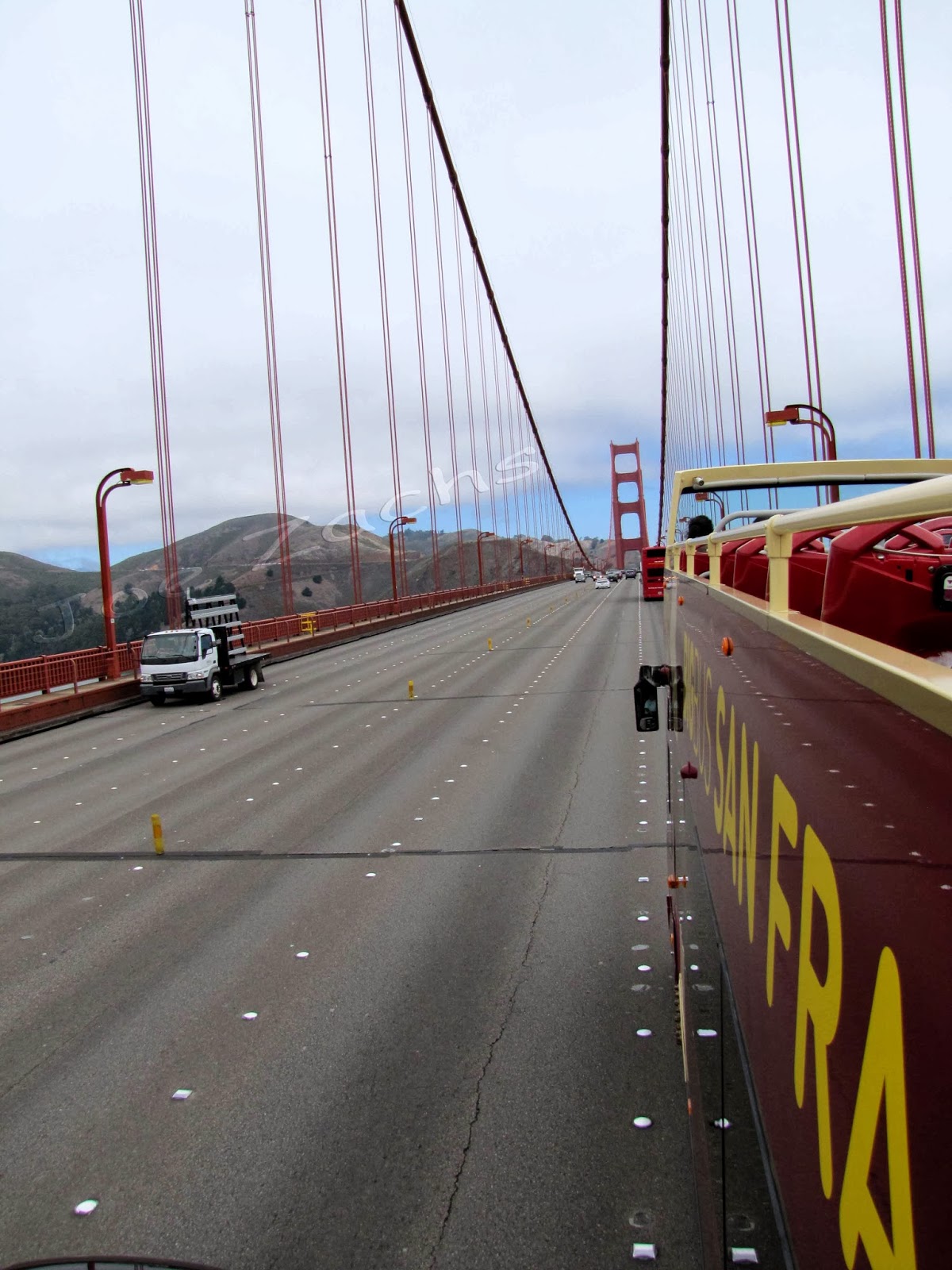
It is really chilly and cold when you cross the bridge (especially if you are at the top deck of the bus)

I tried to capture some parts of the bridge on video (nicely bundled in a scarf and ear muffs with tears rolling down my cheek)


Truly an engineering feat and the most photographed bridge.