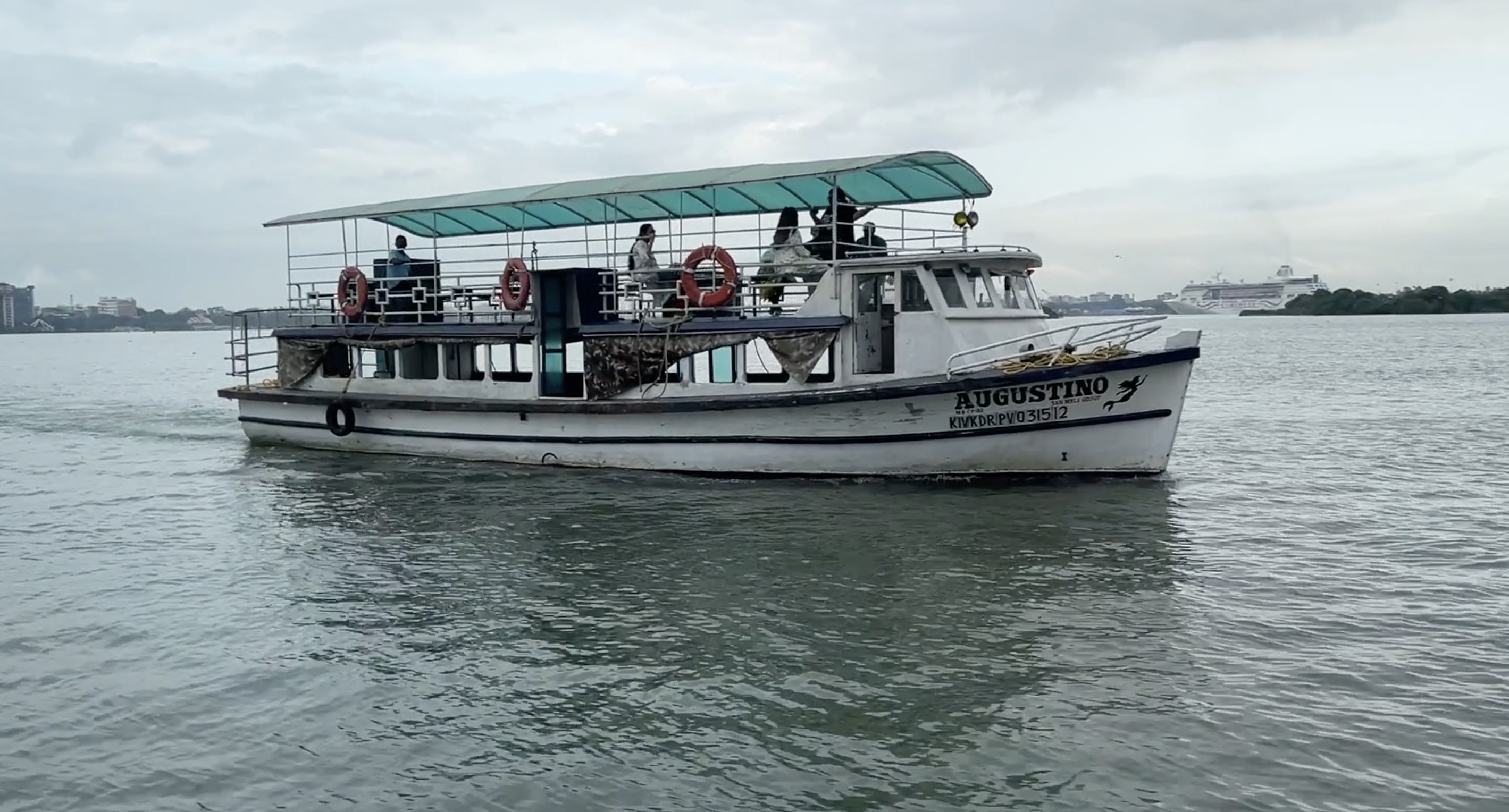
These huge trees must have witnessed these nets being lowered and raised a zillion times. This is one of the views you get to see when you travel by the Kochi water Metro.
Kochi became India's first city to have a water metro project.
The battery operated electric boats were manufactured by Cochin shipyard limited.
Saw these pictures at Fort Cochin terminal where we boarded the Water Metro. Notice the languages? Apart from Indian languages I could identify Russian, Hebrew, French, Mandarin, Japanese, Urdu, and probably many more as I am not a language expert.
Instead of standing in line, you sit in line. I was impressed by the bench they provided. And there is an additional rectangular sitting area for more seats. I feel the architecture of those seats has got something to do with Fort Cochin.
Before you take a seat, you observe the life jacket box which is easily accessible and they are not locked. (I just checked one of the boxes)
We crossed one of the older boats and I was wondering about the noise and vibration one has to endure on them as compared to the battery operated water metro.
It was cost effective too, just Rs 40 as compared to it being ten times more when travelling by a cab for the same distance.
You will get more information while watching the video All in all, it was a good experience and can be added as a "must do things" on your next visit to Kochi. Like the poster says, think blue, go green.
After a long time I travelled by bus in Kerala. The first leg was from Airport to Alleppey (Alappuzha) bus stand, and the second leg was from Alleppey to Changanasserry. The total cost came to Rs 157/-
I captured some pictures and videos from the bus. I could do this only after sunrise as I had started my journey at 4 am. The conductor and the driver got replaced at Ernakulam (as this was a long distance bus which proceeded to Trivandrum after dropping us at Alleppey.)
At Alleppey bus stand I had tea, a repeat exercise for me after nearly 55 years ! The method of making the tea is the same (as can be seen in the video) and the flavour is surprisingly the same. The cost of the tea was just Rs10
Boarded the Changanassery bus from there, with the assumption that it would take me through the same route that I had taken 55 years ago, but there were some changes. When I saw the bus entering Kallu palam (stone bridge) I assumed it would take a right turn and head for Irumbu palam (Iron bridge)
But it went straight ahead towards Kottara palam which was flattened out. Earlier this Kottara palam was built very high so that the Travancore King's boat could pass under it. Now there is no Palace and no King, so I presume that bridge was not required.
Coming back to kallu palam, this area was a trading centre about a century ago.
Once a week, goods (mostly vegetables and pulses) were displayed on the broad steps next to the bridge and trading took place there. It was more of a barter system in those days.
Here is a photo of the Kallu palam clicked by the Government photographer Zacharias D'Cruz. This was clicked way back in 1900
As the bus avoided the city, it reached Kaithavana within no time and I had to quickly click a picture of the church. I found that the church has expanded sideways.
The kodimaram (flag post) is prominent in the middle. This type of kodimaram is usually found in front of churches and temples all over Kerala.
The bus took a turn at Kaithavana mukku (junction) and I found that the junction was pretty clean.
Heading straight towards the east, we reached Pallathuruthi. From the bridge we could see all the houseboats parked nearby. This is the starting and ending point of the Alleppey Houseboats.
About 40 years ago if one had to travel from Alleppey to Changanasseri, one had to cross three ferries namely Pallathuruthi, Nedumdy and Kidangara. With the construction of the bridges, movement became faster.
On either side we could see the paddy fields but now they are slushy with residual rain water.
All said and done, it was a comfortable (and cost effective) journey for me, but I found that all the bus stands that I crossed were in very bad shape and needed a complete makeover. For example I saw a makeshift shelter made by some concerned people at the Changanassery stand.
Hope the present transport minister Mr Ganesh Kumar makes a note of this.
After a week I made my return journey by the same Kerala SRTC Low Floor airconditioned bus. That is another change I noticed. KSRTC is now known as Kerala SRTC.
Terrasinne is a wonderful place to spend a day and be served by people who care for you. It is a Multicuisine Restaurant located at F C road, Pune (near Tukaram Paduka chowk)
Once you are seated, a young girl comes and explains to you how the restaurant functions.
All orders are to be placed with sign language and the menu card has an easy to understand prompt for it.
The food takes some time to come but that is understandable as it is freshly made. The ambiance and the staff put you at ease and that helps you to relax.
The reverse triangle sign of Terrasinne is an Alchemy sign which means 'Earth' (Terra) and Sinne means World Cuisines.
This is one dignified platform for many - 14 disabilities like, blind, deaf, down syndrome, intellectual disability, cerebral palsy, deaf and autistic spectrum, epilepsy..... (just a few to mention)
The founder, Dr. Sonam Kapse ensures that the kitchen does not use preservatives, additives or unhealthy ingredients. Terrasinne has collaborated with 200 plus farmers which encourages the propaganda of farm-to-table food.
Some of the photos I clicked while a food photo shoot was going on.
I heard that group discounts on party bookings are available. I feel more people should patronize the place as it is a win win situation. The joy and happiness you see on their faces is worth it.
I made a short two minute video of them in action.
Before leaving we had Filter coffee and cold coffee from Trelish, and that is something I would personally recommend for the coffee fans.
I like their tip box and I presume the tip is shared by all.
Had been to the Kala Ghoda Festival and took some general pictures of Mumbai, like this night shot of the Mumbai University
Sauntered into the Westside store (opposite Kala Ghoda) and saw these young boys from Live 101 keeping the customers entertained. They were playing my favourite song by Bob Marley.
Marley's classic song No Woman No Cry was inspired by his experience living in the trench town area of Kingston, Jamaica.
The song reflects the hardships and struggles faced by the residents of the ghetto with its lyrics portraying empathy and hope for better times.
The song was recorded in 1974 and the live recording was released as a single in 1975.
The song is meant as an encouragement that life is worth living for - a beacon of hope shining in the darkness.
The title and the main refrain "No Woman no cry" means, Woman, don't cry.
Another non festival picture was this pretty woman trying to sell some trinkets at the Regal crossing.
Mumbai was looking all colourful with the new double decker electric bus
Took me back about six decades when I travelled by tram on the same road and the fare was 10 Ps from Byculla to Regal.
We patronized an old Parsee joint Jimmy Boy in the area for dinner. The "sunny side up on kheema" not only looked great but was really yummy. Their concept is to serve Lagan nu Bhonu (Parsee wedding food) at their restaurant. Jamva Chaloji.
It was heartwarming to see this study centre in the heart of the city where students coming from underprivileged backgrounds can come and study and fans and lights and charging points are provided for them. These two pictures below explain it all. (behind that board you can see youngsters sitting and studying)
Now for some festival shots. This catapult reminded me of the ones we made by cutting the Y from a guava tree and tying rubber strips from discarded cycle tubes. Now it is a part of the Channapatna toys in one of the stalls.
I was impressed by the pencil sketch done by Ashish Mahajan at the Cooperage Bandstand Garden. Had a chat with him and he said that he usually takes about 6 to 8 hrs to finish a pencil sketch of a portrait. (you can see him in action in the video) The charges too were cost effective.
We saw this pottery workshop where one gets a feel of the potter's wheel.
There was an exhibit by the Indian Navy opposite Lion Gate with the title Lest we forget. It was crafted from the recovered memorabilia of INS Vikrant as an offering of everlasting tribute. This too took me down memory lane when I was posted on duty on the Vikrant from the NCC during the Navy week, way back in early 70s.
There was a stall by The Good Doll where each product is handcrafted by women from underserved communities using natural and upcycled materials that are ethically sourced from within the region.
Kala Ghoda is an yearly event and it is a good platform for people to showcase their product/talent. This was started on a small scale 25 years ago. Hope to click more pictures next year.